Photo Credit: Shatabdi Chakrabarti / We Animals
Across Malaysia, conversations about pig farming have moved from quiet rural districts into the national spotlight. While debates often focus on licensing or supply, a deeper question deserves attention: what are the real impacts of industrial pig farming on animals, communities, public health, and the environment?
Environmental Impact of Pig Farming in Malaysia
For many Malaysians, pig farms remain out of sight and out of mind. Yet when operations expand near residential areas, their presence becomes impossible to ignore. Complaints frequently centre on foul odours, flies, wastewater discharge, and polluted rivers.
These concerns are not speculative. A scientific study of the Kereh River in Penang found that untreated swine wastewater significantly degraded water quality downstream of pig farming activity, including elevated ammonia and reduced oxygen levels that threaten aquatic life (PubMed-indexed study). Parliamentary reporting between 2020 and 2024 also confirmed that livestock wastewater has been a recurring contributor to river pollution incidents in Malaysia (The Star report).
Around the region, intensive pig farming has been linked to nutrient runoff, ammonia emissions, and contamination of water sources. Waste lagoons and poorly managed effluent can leach into rivers, affecting aquatic ecosystems and downstream communities.
Disease Risks: Nipah Virus and African Swine Fever
Environmental damage is only part of the picture. Public health risks are another serious concern. Large concentrations of animals in confined spaces create ideal conditions for disease transmission.
Malaysia has experienced this firsthand. During the 1998 to 1999 Nipah virus outbreak, fruit bats carrying the virus contaminated fruit trees near pig enclosures. Pigs became infected after consuming contaminated fruit and acted as an amplifying host, spreading the virus rapidly within farms and to humans in close contact with them (NIH epidemiological review). To contain the outbreak, authorities culled more than one million pigs nationwide (FAO documentation). The human and economic toll was severe, and the event remains one of the most significant zoonotic disease crises in Malaysia’s history.
More recently, African Swine Fever has affected parts of Southeast Asia, including outbreaks detected in Selangor and Penang. Containment measures led to the culling of approximately 76,000 pigs in affected farms (CodeBlue health policy report). Although African Swine Fever does not infect humans, its rapid spread demonstrates how vulnerable dense pig populations can be and how quickly mass killing becomes the default response.
When outbreaks occur, entire herds are destroyed to prevent further spread. Beyond the economic loss, this represents immense animal suffering. It also raises an uncomfortable question: are systems built on high stocking densities and tight confinement inherently unstable?
Animal Welfare in Industrial Pig Farms
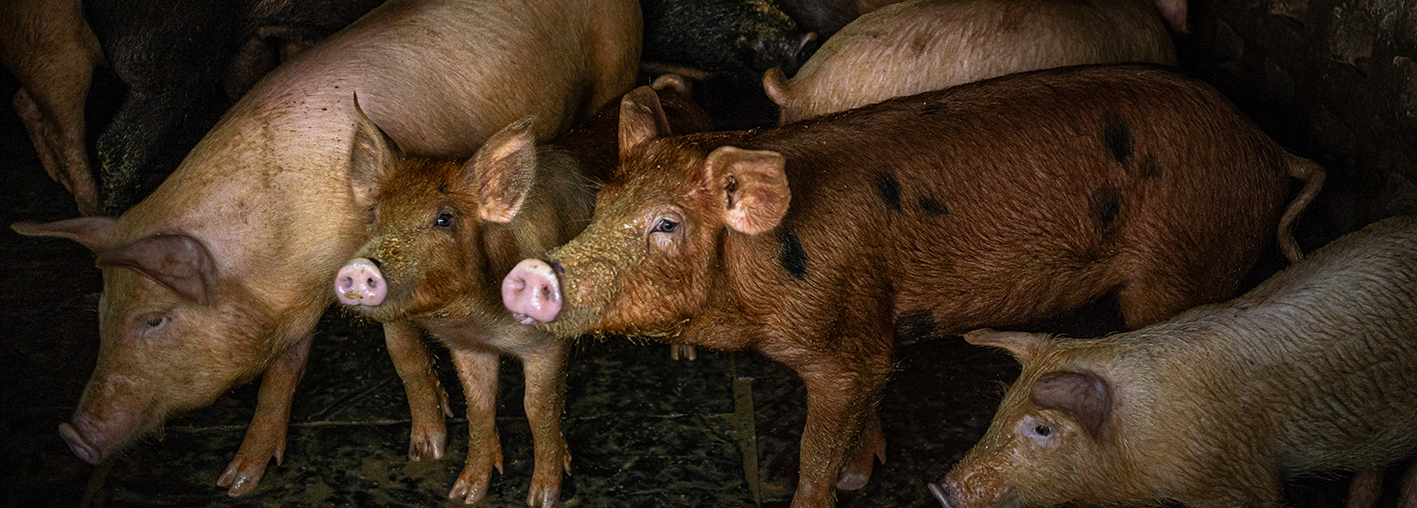
At the heart of this issue are the pigs themselves. Modern industrial pig farms typically confine animals in restrictive housing systems that severely limit natural behaviours. Breeding sows may spend weeks or months in gestation crates so small they cannot turn around. Piglets are often separated from their mothers at a young age. Practices such as tail docking and teeth clipping are used to manage stress-related aggression caused by overcrowding.
Scientific research shows that pigs are intelligent, social animals with strong learning abilities, long-term memory, and problem-solving skills (peer-reviewed cognitive review). When animals capable of complex social and cognitive behaviour are kept in barren, confined environments, welfare concerns are inevitable. Stress, injury, and abnormal behaviours become routine features of the system.
Community Impact and the True Cost of Cheap Meat
The economic argument for pig farming is often framed around food supply and affordability. Pork remains an important protein source for many non Muslim Malaysians. However, the full cost of cheap meat rarely appears on the price tag. Environmental remediation, disease management, public health risks, and animal suffering are costs absorbed by communities and future generations.
Communities living near large scale farms often report limited consultation before expansion. When odours, flies, or water contamination affect daily life, trust in regulators can erode. People deserve transparency about waste management, disease control, and welfare standards. They also deserve meaningful opportunities to voice concerns about what operates in their backyard.
This is not about targeting individual farmers. Many operate within systems that prioritise scale and cost efficiency over sustainability and welfare. Real change requires stronger standards, modernised systems, and a willingness to rethink how food is produced.
Pig farming is not merely a rural matter. It is a national conversation about environmental stewardship, public health resilience, and compassion. Malaysians deserve clean air, safe water, and food systems that do not rely on suffering or environmental harm.The farms in our backyard reflect our collective choices. It is time to ask whether those choices truly serve our communities, our health, and the animals whose lives are at stake.