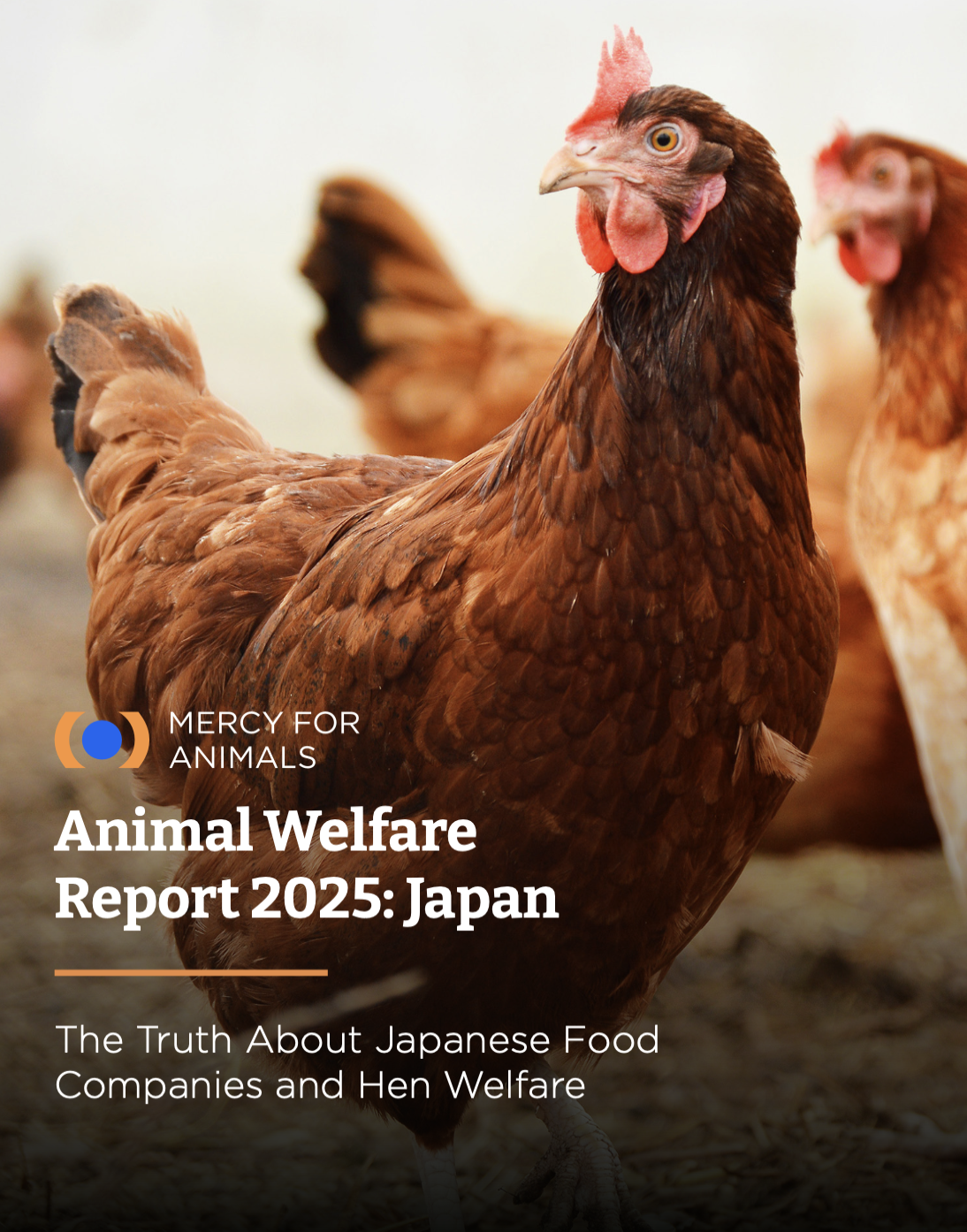
In September 2025, Mercy For Animals released their inaugural Animal Welfare Report 2025: Japan, the first report to evaluate cage-free egg initiatives among Japan’s top global food companies. The multinational companies featured in this report are synonymous with high quality worldwide, and many operate in Malaysia and the greater Asia region, well-known for their retail, food product, and restaurant brands. However, when it comes to improving animal welfare through cage-free commitments, only a few companies are stepping up. The majority are falling far behind, demonstrating the need to keep up with rising global animal-welfare standards and consumer expectations.
Why We Need the Cage-Free Movement to Improve Laying Hen Welfare
With a population of around 8.3 billion birds, the laying hen is the world’s most farmed land animal. Asia is the world’s largest egg producer, accounting for about 64% of global production, holding a significant opportunity to better welfare for potentially billions of animals. Unfortunately, the majority of laying hens in Asia (around 95% or more in Japan) still spend their lives trapped in battery cages—wire enclosures so small that the animals can’t spread or flap their wings.
This confinement system is inherently cruel, causing injury, disease, and extreme stress while denying hens the ability to perform natural behaviors, like nesting and dustbathing. Scientific studies show that cage-free housing alleviates a significant amount of suffering for laying hens, reducing pain, stress, and disease while providing the opportunity for them to express behaviors crucial to their wellbeing.
With proof of the cruelty of battery-cage systems and demand from stakeholders, hundreds of global food companies have committed to going cage-free, many pledging to complete the transition by the end of 2025. Yet in Japan, most companies lag far behind. These include Japan-based companies that operate abroad, whose cage-free commitments extend only to European or North American countries, even though hens around the globe deserve fair treatment everywhere.
Report Highlights and Disappointments
Japan’s leading mayonnaise manufacturer has committed to increasing the use of cage-free eggs in Kewpie mayonnaise, a popular product globally, from the current 3% to 10% in 2027.
The company has also expressed interest in using cage-free credits for their Asian markets. In Malaysia, Kewpie manufactures and sells mayonnaise, dressings, and other food products.
The Japan-based retail giant AEON is well-known throughout the greater Asia region and has pledged to go 100% cage-free in Malaysia. AEON can strengthen their pledge by adding a timeline to their cage-free goals for Malaysia and extending their cage-free policy globally to include all locations the company operates in.
Seven & i Holdings, known best for 7-Eleven, their global convenience-store chain, is a multinational retailer headquartered in Japan. They sell cage-free eggs in some retail locations in Japan, yet the company’s current cage-free statement extends only to their locations in the United States and Canada. There are around 2,400 7-Eleven locations in Malaysia, making 7-Eleven the largest convenience-store chain in the country.
Zensho Holdings, one of the largest restaurant-chain operators in Japan and the greater Asia region, has published no statements or initiatives promoting hen welfare to date and should publish a global cage-free commitment. The company operates some of the top chain restaurants in Asia, including Sukiya and The Chicken Rice Shop in Malaysia.
Why This Matters
Japan is already ranked one of the lowest among G7 nations for farmed animal protection, and the country’s biggest companies have consistently scored poorly on global animal welfare benchmarks. Without decisive action, Japan risks falling even further behind, jeopardizing its international reputation for quality and responsibility. Moreover, Japanese companies’ hesitations could also hinder other countries’ progress in raising animal welfare standards.
The good news? Change is possible. Other Asia-based companies, like Jollibee (Philippines), Super Indo (Indonesia), and Carrefour (Taiwan), have already pledged to go 100% cage-free, proving that progress is both achievable and impactful in Asia.
Learn More!
Hens in Japan deserve better. Corporate leaders must take responsibility and publish time-bound global cage-free commitments.
Read our full report and learn for yourself why Japan and Asia’s leading food companies need to make cage-free pledges and lead the way towards a kinder food system.